
Why Machine Downtime Costs More Than Labor in Cannabis Manufacturing
Machine downtime looks like "lost minutes." In reality, it is usually the most expensive event on a cannabis production floor because it stops the only asset that reliably scales output: a controlled, documented line converting materials, labor, and compliance controls into sellable units. While labor pauses can often be redistributed, a down line typically creates immediate backlogs, missed ship windows, rushed restarts, and quality risk that can cascade into holds or rework.
This cost profile shows up across the industry. In ABB's 2025 global survey-based downtime report, 83% of decision-makers estimated unplanned downtime costs at least $10,000 per hour, and 76% estimated it can reach up to $500,000 per hour, depending on the operation and severity.
That's why, in cannabis manufacturing, downtime reduction often outperforms labor cuts as a profitability lever. This guide breaks down where downtime actually "charges you" (throughput loss, scrap, compliance disruption, and schedule damage) and how to build a practical approach to prevention, response, and recovery so uptime translates into consistent, defensible output. For many, the first step is to scale cannabis business robotic packaging to ensure the end of the line never becomes the bottleneck.
Downtime Is a Cost Stack, Not a Single Number
Downtime is rarely just "minutes lost." In real plants, an unplanned stop triggers a chain reaction: lost output, emergency overtime, wasted in-process materials/energy during shutdown and restart, knock-on reliability issues ("failure debt"), and even inventory/logistics disruption if the right parts are not immediately available.
Lost Gross Margin Is the Obvious Loss
When the line is down, you are not producing sellable units, so you lose the margin you would have generated during that runtime. This is the headline cost, but it is only the first layer. This is why many facilities seek custom robotics integration services to build redundancies into their workflow.
Secondary Losses Compound the Hit
Unplanned stops typically create restart drift and extra work: more rejects, more holds, more rework, more line-clearance and verification steps, and more end-of-shift debt. Even after the machine restarts, the system can remain unstable long enough to keep output and quality below plan.
Labor Is Paid Either Way
Labor is largely fixed across the shift you scheduled. When equipment stops, the payroll clock does not. Operators wait, supervisors troubleshoot, QA pauses, or re-checks, and overtime often gets added to recover the schedule, so you pay labor plus the rest of the downtime stack.
What is the fastest way to estimate downtime cost?
Start with (sellable units per hour × contribution margin per unit), then add three common multipliers: overtime created, scrap/rework from restart drift, and any compliance holds/re-testing triggered by the event.
Cannabis Lines Amplify Downtime Costs More Than Most Industries
Cannabis manufacturing tends to turn “simple downtime” into a multi-layer event because quality, identity, and documentation must remain defensible across every stop, restart, and handoff. The same 30-minute stoppage that is inconvenient in a lightly regulated environment can become expensive in cannabis because it triggers extra controls, extra checks, and a higher risk of batch disruption.
In regulated manufacturing, documentation failures are among the most common compliance issues cited by regulators. On average, approximately 20-25% of FDA warning letters issued to pharmaceutical manufacturers cite subpar documentation as a major deficiency during inspection of current good manufacturing practices. This clearly reflects how quickly inadequate record control can escalate compliance risk and cost.
Compliance and Traceability Make Restarts Expensive
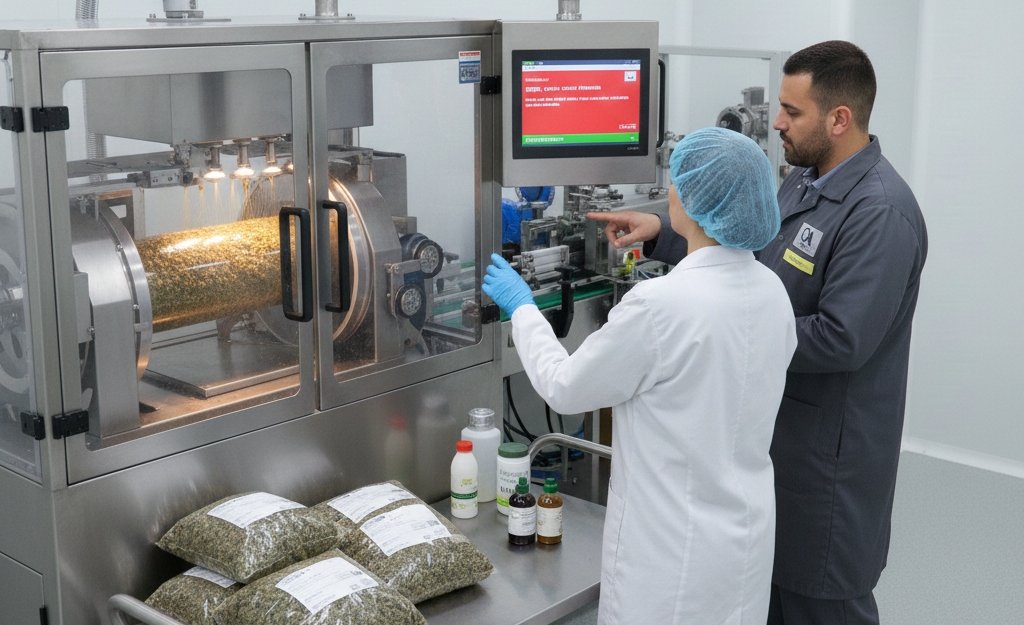
Cannabis infusion machine being restarted after downtime with operators monitoring labeled materials and error alerts
In cannabis, a stop is rarely “just a stop.” It often triggers line clearance, label reconciliation, batch status confirmation, and QA verification, especially on packaging lines where identity and labeling are part of product compliance. The restart cost is frequently the proof-of-work: showing what is true, what remained controlled, and what is safe to release.
Yield Loss and Product Handling Risk Increase
Many cannabis processes are sensitive to time, temperature, exposure, and handling. A stoppage can push material out of its best operating window, increase handling steps, and introduce variability that only shows up later as weight drift, package integrity issues, potency variance, or customer complaints. Downtime becomes expensive because it increases the chances of rework, scrap, or conservative holds.
Multi-SKU Packaging Makes Small Errors Costly
Frequent SKU changes and high label sensitivity make every stop a “mix-up risk moment.” Even when nothing ships incorrectly, the work required to confirm correct components, labels, batch ID, and counts can be substantial. On a cannabis line, proving you stayed in control can take longer than the mechanical fix. Implementing an automated sorting system can reduce these manual verification steps.
Is downtime risk only about missed shipments?
No. In regulated environments, the bigger risk is often loss of control, holds, investigations, rework, and reduced confidence in batch defensibility.
Downtime vs Labor: Why Downtime Usually Wins as a Savings Target
Labor savings tend to be clean and visible, but they are usually incremental. Downtime reduction often delivers outsized returns by increasing throughput at the constraint, stabilizing quality, and reducing the secondary costs that follow every disruption.
The Line Is the Bottleneck and the Profit Engine
Most facilities are constrained by a small number of lines or critical stations. Cutting labor reduces hourly spend, but reducing downtime increases output of the constraint, so you gain more sellable units without adding new fixed assets. If the constraint moves, the economics move with it. Many operators automate infused pre-roll production to ensure their most profitable lines stay active. If the constraint moves, the economics move with it.
Downtime Creates Overtime and Expediting
When shipments are due, missed hours return as overtime, weekend work, expedited freight, and rushed decisions. You often pay the labor anyway, just at higher rates and with higher error probability. Downtime cost includes the recovery tax.
Labor Savings Are Linear; Uptime Gains Are Multiplicative
A labor reduction saves what you remove. Downtime reduction improves multiple drivers at once: throughput, schedule reliability, changeover stability, QA rhythm, and planning accuracy. The benefit stacks, which is why downtime frequently outperforms labor cuts as a profitability lever.
When does adding labor still beat reducing downtime?
When downtime is already low, and the true constraint is manual capacity (for example, hand-pack or inspection bottlenecks). The key is confirming where the constraint actually is before you optimize the wrong lever.
The Downtime Patterns That Quietly Dominate Cannabis Production
Most “big downtime problems” are not dramatic breakdowns. They are repeatable losses that feel normal: changeovers that drift, staging gaps, label issues, and small micro-stops that quietly consume hours.
Changeovers and Cleaning Windows
In cannabis, cleaning and changeovers are part of staying in control. When they are inconsistent, they expand. When they expand, they become the real capacity ceiling. High-performing lines treat changeovers as engineered routines, defined steps, defined owners, defined start/finish criteria, not informal events.
Material and Label Readiness Failures
Many "equipment issues" are actually readiness issues: missing labels, wrong components staged, unverified WIP status, delayed QA release, or tools that are not at the point of use. These stops are preventable, but only if you design staging rules, verification steps, and accountability into the operating system. For automated lines, ensuring consistent cannabis pre-roll seals requires that the right adhesives and papers are verified before the run starts.
Micro-Stops That Add Up Across the Day
Short stops feel harmless until you add them across a full day. Dozens of resets, jams, sensor faults, and minor adjustments fragment the run, creating repeated recovery cycles. The cumulative loss can exceed a major failure because it steals time without triggering urgency.
Which downtime should we fix first?
Start with the frequent, repeatable stops, even if each is small. Frequency is usually the first engineering target, not severity.
How to Build Downtime Resistance Into the Operating System
The best plants treat downtime as a system design problem, not a maintenance problem. The goal is not "never stop." The goal is: stop cleanly, restart predictably, and prevent small failures from turning into unstable production.
Standard Work That Makes Restarts Predictable
Downtime hurts most when every restart is improvised. Define restart ownership, required checks, first-off acceptance, and the exact sequence to return to steady-state. When the restart is consistent, a 10-minute stop remains a 10-minute stop rather than turning into a 90-minute slump.
Maintenance Planning That Prevents Night-Shift Failures
Multi-shift operations punish weak preventive maintenance and weak spares readiness. If a minor part is missing at 2 AM, the real cost is not the part; it is the lost run window, the forced schedule changes, and the overtime required to recover. Build a "night-proof" readiness standard: critical spares, defined escalation, and clear first-response troubleshooting boundaries.
Cleaning and Maintenance Procedures Must Be Written, Owned, and Recorded
If you operate under cGMP expectations, you need cleaning and maintenance that is controlled, consistent, and auditable. That means clear ownership, defined schedules, defined methods, and records that prove the condition of equipment before use. Operationally, this is what keeps cleaning windows from turning into chaos and changeovers from becoming arguments.
Do we need automation to reduce downtime?
Not always. Many facilities unlock large gains with standardized changeovers, better staging, clearer ownership, and disciplined maintenance before buying new equipment.
Make Downtime Visible With Metrics That Drive Action

If downtime is not categorized consistently, it will be debated instead of solved. A small, reliable measurement system is usually more valuable than a complex dashboard that nobody trusts. One shared view of “where the time went”.
Use one downtime log with consistent categories (changeover, cleaning, material wait, QA hold, breakdown, micro-stop). If teams cannot agree on “what happened,” you will not fix it. Shared definitions create shared action.
Treat Downtime Like a Portfolio of Losses
Most plants have a "top five" that creates most of the pain. Review it weekly, assign owners, and close actions with evidence (reduced frequency, reduced minutes, or eliminated recurrence), not opinions.
Connect Downtime to Cost
"Lost 90 minutes" feels abstract. "That stop cost more than a full shift of labor” changes priorities fast. Translate downtime minutes into impact using sellable units lost, overtime created, and scrap/rework from restart drift.
What should be tracked daily?
Sellable units per shift, downtime minutes by category, top stop codes, and changeover duration are usually enough to drive real improvement.
A Practical 30, 60, 90 Approach to Reducing Downtime
Downtime reduction works best when you establish repeatability first, then remove the biggest repeatable losses, then redesign the systems that drive chronic stops.
First 30 Days: Measure and Stabilize
Lock downtime categories, enforce clean handoffs, and standardize restarts. The goal is repeatable execution before aggressive optimization.
Next 60 Days: Eliminate Repeatable Losses
Pick the top two or three recurring stops and remove them with engineering fixes, preventive routines, and training tied directly to standard work. Do not spread effort across ten problems.
Next 90 Days: Redesign Changeovers and Spares
Make changeovers predictable, eliminate “search time” for tools/materials, and implement a critical spares system that prevents long night-shift outages. By day 90, downtime should be trending down for the same top causes, not just shifting to new categories.
How do we avoid over-analysis?
Only track what you will act on. If a metric does not lead to a weekly decision or a clear owner action, remove it.
Build More Capacity by Buying Back Uptime
In cannabis manufacturing, labor is visible, but downtime is usually the larger profit leak. Downtime stops margin generation, creates overtime and rework, increases compliance friction, and destabilizes the very controls that keep production defensible.
If you want the highest-ROI path to scale, start by treating downtime as a system-design problem: stabilize changeovers and cleaning, tighten staging and label control, define restart ownership, and build maintenance readiness that prevents predictable failures.
Ready to reduce downtime and convert lost hours into real capacity? Sorting Robotics helps cannabis manufacturers design production systems that stay stable under real operating conditions. Our Jiko and Jiko+ pre-roll infusion machines, Stardust kief coating machine, and custom integration and automation services are built to reduce restart drift, tighten changeovers, and support predictable uptime across shifts.
Contact us to review your downtime patterns, quantify the true cost per stop, and design an uptime strategy that increases sellable output without adding headcount.
Frequently Asked Questions
What is the simplest definition of downtime cost in cannabis manufacturing?
Downtime cost is the total financial impact of not producing sellable, compliant units when the line should be running. It includes lost contribution margin, paid labor sitting idle, restart losses (scrap and rework), and any compliance-driven holds or extra verification triggered by the stop.
If labor is expensive, why does downtime still cost more?
Because downtime often keeps labor costs in place while eliminating the output that labor is supposed to produce. You typically pay the same shift wages, then add overtime or expediting to recover volume, plus the quality and compliance overhead that increases when processes stop and restart.
What downtime category is most “invisible” in cannabis plants?
Material-and-label readiness delays are often the most invisible because they look like “waiting,” not “breakdowns.” In practice, late QA release, missing labels, mismatched components, unclear WIP status, or staging gaps can stop a line just as hard as a mechanical fault, and usually happen more often.
How do I know whether my bottleneck is downtime or labor capacity?
If the line frequently stops, starts late, or loses the first hour after changeovers, downtime is likely the constraint, even if you feel short-staffed. If the line is consistently available and stable, but manual stations cannot keep up even when fully staffed and well-staged, then labor capacity (or ergonomics and station design) is the constraint.
What is the most practical first step to reduce downtime without buying new equipment?
Standardize the restart and changeover routine and enforce a “ready state” handoff between shifts. When every stop has a consistent recovery path, and every shift inherits a staged, verified, documented starting condition, you reduce restart drift, prevent repeat errors, and convert more scheduled hours into sellable units.