
Role of Standard Operating Procedures (SOPs) in Automated Cannabis Facilities
Standard Operating Procedures (SOPs) are written, approved instructions that define how regulated manufacturing tasks are performed, controlled, documented, and reviewed. In automated cannabis facilities, SOPs govern not only operator actions but also the configuration, monitoring, adjustment, and restart of robotic systems during both normal and exception operations.
In its Data Integrity and Compliance With Current Good Manufacturing Practice (CGMP) guidance, the U.S. Food and Drug Administration states that manufacturing processes must be clearly defined, executed as written, and supported by complete, consistent, and contemporaneous records to ensure product quality and regulatory compliance. The agency further notes that failures in procedural control and data integrity have led to warning letters, import alerts, and enforcement actions.
As cannabis manufacturing increasingly relies on automation for infused pre-rolls, concentrates, and high-potency products, SOPs become the control framework that determines whether automation delivers stable, compliant output or amplifies operational risk.
Why SOPs Are the Control Layer That Makes Automation Reliable
Automation executes physical steps with precision, but SOPs define the rules that govern how those steps are approved, monitored, and corrected. Without SOPs, machines may operate correctly, while human responses to alarms, overrides, restarts, documentation, and release decisions vary from shift to shift.
A systematic literature review published on ScienceDirect examining software compliance failures found that a majority of incidents stem from human behavior, unclear procedures, and weak policy enforcement rather than technical malfunction. This demonstrates that reliability in automated systems depends as much on procedural discipline as on technology.
SOPs Define the Intended State of the Process
SOPs define normal operation by clearly documenting approved configurations, acceptable limits, verification points, and release criteria. When this intended state is formally defined, operators no longer rely on memory or personal judgment. Instead, they follow a shared standard that keeps automated output consistent across operators, shifts, and production runs.
SOPs Standardize Decisions During Exceptions

Automated systems inevitably generate alerts and deviations. SOPs reduce variability by defining required first actions, root-cause evaluation steps, escalation thresholds, and restart authority. The ScienceDirect review highlights that unclear exception handling is a major driver of compliance breakdowns, reinforcing the need for predefined procedural responses.
SOPs Make Training Repeatable and Defensible
The reviewed research emphasizes that compliance failures frequently arise from gaps between written policies and day-to-day behavior. SOPs close this gap by converting informal knowledge into standardized routines, enabling consistent training, reliable cross-coverage, and defensible audit outcomes.
If machines are automated, do SOPs still matter?
Yes. Automation reduces manual work, but it increases reliance on consistent human decisions. SOPs ensure those decisions remain aligned, documented, and compliant as automation scales.
How SOPs Prevent the Three Most Common Automation Failures
In regulated manufacturing, automation failures rarely appear as sudden breakdowns. They usually develop as slow losses of control that go unnoticed until they surface as deviations, audit findings, or batch losses. SOPs prevent these failures by setting firm boundaries around how automated systems are configured, adjusted, and documented, ensuring consistency does not erode over time.
Drift Control Through Calibration and Change Management
Process drift occurs when calibration routines, verification checks, or recipe updates are handled informally or inconsistently. SOPs prevent this by clearly defining calibration intervals, pre-run checks, and approval authority for any parameter changes. When these controls are documented and enforced, automated systems remain aligned with their validated operating state rather than gradually shifting through undocumented adjustments.
Bypass Control for Overrides and Manual Modes
Every automated facility eventually faces pressure to override alarms or bypass interlocks to keep production moving. SOPs establish when overrides are allowed, who has the authority to approve them, and how each action must be documented. This prevents short-term throughput decisions from undermining long-term process control and compliance. Following key safety tips when operating infusion machines ensures that manual bypasses don't lead to accidental injuries or contaminated batches.
Data Gap Control Through Complete Records
Automation generates large volumes of data, but gaps still occur when timestamps are missing, responsibilities are unclear, or exceptions go undocumented. SOPs define how data is captured, reviewed, and retained so that automated records remain complete, attributable, and reliable. This ensures automation strengthens traceability rather than creating blind spots.
What should be included in an alarm-response SOP?
An alarm-response SOP should define the immediate safe-state action, initial diagnostic checks, escalation thresholds, restart authorization, and the documentation required before production resumes.
SOPs for Packaging, Labeling, and Reconciliation in Automated Lines
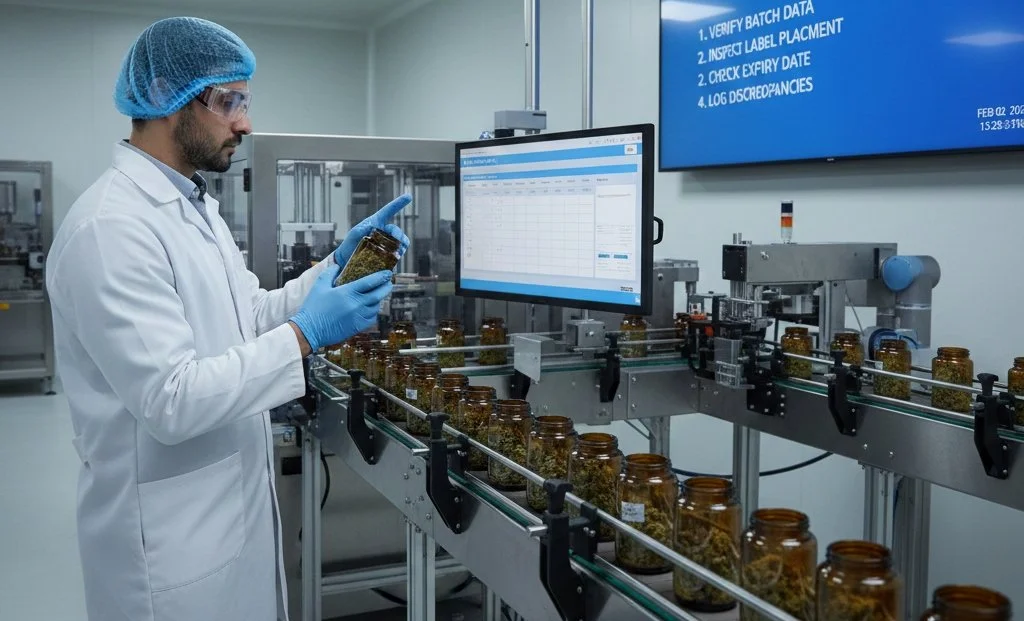
Packaging and labeling remain high-risk stages in cannabis manufacturing. While automation reduces manual error, SOPs determine whether verification and reconciliation steps are consistently executed or gradually bypassed under production pressure.
Line Clearance and Label Control
SOPs define how prior materials are removed, how new SKUs are staged, and how label versions are verified before a run begins. Most label mix-ups occur not because machines fail, but because line clearance or verification steps are rushed or skipped during changeovers. Implementing a robotics integration roadmap from pilot to full production helps build these checks into the system's DNA from day one.
Reject Handling and Exception Control
When automated inspection systems reject product, SOPs determine how those units are isolated, reviewed, and dispositioned. Clear procedures prevent rejected units from quietly re-entering compliant inventory, where they can create significant downstream risk.
Reconciliation and Batch Closeout
Even in highly automated lines, human reconciliation remains essential. SOPs standardize yield calculations, scrap tracking, and batch closeout, ensuring every production run ends with a complete, consistent record package.
What is the fastest way to reduce packaging errors?
Standardizing line clearance, label verification rules, and reconciliation closeout procedures produces the most immediate and reliable reduction in packaging-related exceptions.
SOPs for Cleaning, Changeovers, and Maintenance Around Automation
Higher throughput increases exposure to cleaning cycles, changeovers, and maintenance events. SOPs prevent these routine activities from becoming inconsistent or dependent on individual habits.
Cleaning SOPs: Define Ownership and Release
Cleaning SOPs clearly assign responsibility, define methods, and require verification before equipment is returned to production. This ensures each run starts with known equipment conditions rather than assumptions carried over from the previous shift. For instance, knowing how to clean and maintain your kief machine prevents cross-contamination between batches.
Changeover SOPs Reduce First-Hour Variability
Most changeover losses occur after restart, not during mechanical adjustments. SOPs that include first-off checks and early verification help stabilize output quickly and reduce variability during the most vulnerable production window.
Maintenance SOPs Keep Downtime Predictable
Defined spare parts lists, escalation paths, and planned maintenance windows prevent small equipment issues from escalating into extended outages, particularly during nights or weekends.
Should equipment be cleaned after every shift?
Not necessarily. What matters is a documented schedule, a defined cleaning method, verification before use, and records that confirm equipment condition at the start of each run.
SOPs Inside Digital Systems: eBR, MES, and Automated Logs
As automation expands, electronic records replace paper documentation. SOPs define how these digital systems operate within the quality framework.
Official Records and Electronic Signatures
SOPs clarify which electronic records are considered official, who is authorized to approve them, and how electronic signatures are applied. This prevents ambiguity when digital systems are used as primary evidence of control.
Audit Trails, Access Control, and Versioning
SOPs define user access, audit-trail review requirements, and approval workflows for changes to recipes, labels, and master data. These controls ensure automated data remains traceable, attributable, and reviewable.
Downtime and Recovery Procedures
When systems go offline, SOPs specify what production activities may continue, what must stop, and how records are captured during recovery. This prevents uncontrolled workarounds during system interruptions.
Do automated cannabis facilities need to comply with Part 11?
It depends on the regulatory posture and customer expectations, but when electronic records are used to demonstrate control, Part 11 principles provide a widely accepted, defensible framework.
SOPs in Automated Infused Pre-Roll Manufacturing
Infused pre-roll manufacturing combines flower, concentrates, heat, and precise material placement, making it one of the most operationally sensitive areas in cannabis production. While automation delivers repeatability, SOPs define the boundaries that ensure it remains compliant, stable, and auditable.
SOPs for Concentrate Dosing and Placement Accuracy
SOPs establish approved dosing ranges, placement depth, and positional tolerances for infused cores. These controls are critical for maintaining consistent burn behavior, potency distribution, and label accuracy. By clearly defining acceptable limits and verification steps, SOPs prevent small placement deviations from compounding into batch-level failures.
SOPs for Handling High-Viscosity Concentrates
Materials such as rosin and high-potency distillates introduce variability due to temperature sensitivity and flow behavior. SOPs define heating parameters, transfer methods, and restart conditions to ensure concentrates remain within approved handling windows. This protects both product integrity and equipment performance during continuous runs.
SOPs for Kief and Powdered Concentrate Coating
Uniform coating requires controlled application rates, dwell times, and visual acceptance criteria. SOPs document these variables and define how deviations are identified and corrected. This ensures automated coating remains visually consistent and does not drift outside approved specifications over time.
Do infused pre-roll SOPs need to be product-specific?
Yes. Because infusion methods, concentrate types, and coating techniques vary significantly, SOPs should be tailored to each infused SKU family rather than relying on a single generic procedure.
How to Build SOPs That Actually Get Followed
Well-written SOPs only create value if they can be executed reliably under real production conditions. In automated facilities, SOP usability directly affects consistency, compliance, and downtime.
Write SOPs for Execution, Not Appearance
Effective SOPs use clear language, defined ownership, and step-by-step actions that align with how work actually occurs on the floor. Ambiguous instructions or overly theoretical language increase the likelihood of workarounds and inconsistent execution.
Place Decisions Where Operators Need Them
SOPs should include explicit pass-fail criteria and go-or-no-go thresholds at the exact points where operators must make decisions. This reduces hesitation, misinterpretation, and undocumented judgment calls in high-pressure situations.
Train to Certification and Requalify on Change
Initial training alone is not sufficient. SOPs must be supported by certification-based training and mandatory requalification following equipment upgrades, recipe changes, or process modifications. This ensures execution remains aligned with the approved procedure as operations evolve.
How many SOPs are too many?
When operators cannot quickly locate the correct procedure, or when multiple SOPs describe the same process with minor differences. SOPs should be organized around workflows and decision points, not departments or job titles.
SOPs Are the Backbone of Controlled Automation
Automation increases speed and scale, but SOPs ensure that growth does not come at the expense of control. In automated cannabis facilities, SOPs stabilize daily operations, protect compliance, and reduce downtime by defining how people, machines, and data interact under both normal and exception conditions. They transform robotics from a productivity upgrade into a controlled manufacturing system that can withstand audits, recalls, and rapid production demands.
For cannabis manufacturers scaling infused pre-roll production, SOP maturity is not optional. It is the foundation that determines whether automation delivers consistent, defensible value or quietly amplifies operational risk. Clear, enforceable SOPs make quality repeatable, training scalable, and expansion predictable across shifts and facilities.
If your operation is growing faster than your procedures, now is the time to act. Sorting Robotics helps cannabis manufacturers align automation equipment with SOPs built for compliance and scale. Contact us today to discuss how disciplined automation can support reliable, high-margin growth.
Frequently Asked Questions
Do SOPs need to change when new automation equipment is installed?
Yes. Any new automation system introduces different operating parameters, alarms, data outputs, and failure modes. SOPs must be reviewed and updated to reflect new equipment configuration, startup procedures, exception handling, and documentation requirements, ensuring the written process matches actual operations.
Who should own SOP approval in an automated cannabis facility?
SOP ownership should sit with the quality or compliance function, with input from operations and engineering. This separation ensures procedures reflect real production needs while remaining independently reviewed, approved, and enforced.
Can automation reduce the number of SOPs a facility needs?
Automation can reduce manual task variability, but it does not eliminate the need for SOPs. In many cases, automation increases the importance of SOPs by requiring clearer rules for configuration, alarms, overrides, data review, and system access.
How often should SOPs be reviewed in automated environments?
SOPs should be reviewed on a defined schedule and immediately after equipment changes, software updates, recipe modifications, or recurring deviations. Regular review prevents gaps between documented procedures and actual production behavior.
Are SOPs required even if a facility has experienced operators?
Yes. Regulators evaluate whether processes are controlled through written procedures, not individual experience. SOPs ensure consistency across shifts, protect institutional knowledge, and prevent performance from depending on specific personnel.