
How Dispensary Buyer Preferences Influence Pre-Roll Manufacturing Decisions
Dispensary buyers determine which pre-rolls make it to consumers, and their preferences directly shape how those products are manufactured, infused, packaged, and scaled. In today’s competitive cannabis retail environment, shelf space is limited, and only products that perform consistently earn repeat orders. Buyers focus on pre-rolls that sell reliably, arrive on time, pass compliance testing, and protect retail margins.
When a product underperforms or creates operational challenges, buyers respond quickly by reducing orders or removing the SKU entirely. Manufacturers that fail to align production with these expectations struggle to maintain long-term shelf placement, regardless of brand story or strain quality. This is why many top-tier brands now utilize cannabis robotics manufacturing improves consistency to ensure every batch meets the strict physical standards required by retail partners.
Market data shows how buyer preferences shape the pre-roll market. According to a report from Custom Cones USA and Headset, pre-rolls brought in more than $4.1 billion in sales and over 394 million units between January 2023 and June 2024. The category also posted the highest year-over-year revenue growth among all cannabis segments, highlighting the importance of steady sell-through, repeat purchases, and reliable availability.
This guide explores how dispensary buyer behavior influences pre-roll manufacturing at every stage, from quality control and infusion methods to automation, pricing, and scaling strategies.
Dispensary Buyers Drive Pre-Roll Manufacturing Strategy
Dispensary buyers sit between pre-roll production and retail performance, making them the final gatekeepers of which products succeed in the market. Their approval determines which SKUs are stocked, reordered, expanded, or removed from shelves.
Buyers evaluate pre-rolls through an operational and financial lens rather than a branding one. They prioritize products that sell consistently, can be replenished without disruption, pass compliance reliably, and do not create extra labor or customer complaints at the store level. When a pre-roll introduces friction, such as inconsistent quality, missed delivery windows, or unpredictable performance, buyers respond quickly by reducing orders or delisting the SKU.
This dynamic forces manufacturers to design production systems around buyer expectations instead of internal convenience or one-off production capabilities. Over time, this buyer behavior shapes how pre-rolls are manufactured. Production methods that introduce variability, slow replenishment, or compliance risk are phased out, while systems that deliver repeatable quality and dependable output become the standard for brands that maintain shelf presence.
Why Dispensary Buyers Control What Gets Manufactured
Buyers approve SKUs that minimize retail risk and protect margins. Pre-rolls that burn unevenly, fail testing, or arrive late increase store-level workload and customer dissatisfaction. Each issue adds friction at the retail level, signaling unreliable supply. As a result, buyers gravitate toward manufacturers with stable, repeatable production processes that reduce operational strain.
How Shelf Space Decisions Affect Production Volume
Shelf space is limited and competitive. Once a buyer allocates space to a pre-roll, they expect consistent sell-through and reliable replenishment. Manufacturers that cannot meet these expectations risk losing shelf placement, reducing order volume, and long-term revenue. Predictable products, on the other hand, often earn expanded placement and larger recurring orders.
Why Do Dispensary Buyers Favor Predictable Manufacturers?
Predictable manufacturers make inventory easier to manage, reduce retail headaches, and support steady sales, which is why buyers prioritize them for long-term shelf placement.
Product Quality Attributes Buyers Expect First

Consistent pre-roll quality with uniform construction, even burn, and smooth draw for dispensary approval
Product quality is the first and most unforgiving filter in dispensary buyer evaluations. If quality is inconsistent, no amount of branding, strain naming, or packaging design can protect a pre-roll SKU from being deprioritized or removed.
Buyers quickly learn about quality issues through customer feedback and store staff reports. Problems like uneven burn, tight draw, or fragile construction often lead to returns, negative reviews, and staff complaints. Rather than blaming retail handling, buyers usually trace these issues to manufacturing processes, materials, and quality controls. As a result, quality failures directly influence reorder decisions and shelf longevity.
This buyer behavior aligns with consumer preference research published in Agricultural & Food Economics Research. The study on consumer preferences for cannabis products with THC content found that consumers place the highest value on product attributes tied to experience reliability, including effect consistency, product integrity, and packaging quality. Beyond potency, consumers favored products that delivered predictable performance and clear quality signals, reinforcing why buyers prioritize manufacturing consistency over marketing claims.
Burn Quality And Draw Consistency
Pre-rolls must burn evenly and draw smoothly from start to finish. Poor airflow, canoeing, or frequent relighting signals weak process control and inconsistent material handling. Buyers view these issues as manufacturing failures that increase customer dissatisfaction and returns.
Visual Uniformity Across Units
Buyers expect every pre-roll in a case to look identical. Differences in coating coverage, cone shape, or finish create doubts about quality control and batch reliability. Visual inconsistencies signal variability in production methods and erode buyer confidence.
Structural Integrity During Transport And Storage
Pre-rolls must maintain their shape through packaging, shipping, and retail handling. Bent cones, cracked papers, or loose tips increase breakage and return rates. Buyers associate these defects with poor manufacturing tolerances rather than logistical mishandling.
Why Do Dispensary Buyers Prioritize Quality Consistency Over Branding?
Because consistent quality reduces returns, protects customer trust, and ensures predictable sell-through, outcomes buyers value more than brand storytelling alone.
Potency And Infusion Preferences Shape Production Methods
Buyer demand for high-potency pre-rolls has reshaped how pre-rolls are manufactured across the industry. Potency is no longer just a marketing claim; it is a production requirement that must be delivered consistently at scale.
Infused pre‑rolls now dominate the category and premium shelf space. According to the same Headset‑linked data, the connoisseur/infused segment accounted for about $1.75 billion in sales, outpacing traditional single‑strain pre‑rolls and growing its share to roughly 44 % of the market by early 2024. These statistics show how strong consumer and buyer demand is for consistent, premium-infused products. A Jiko robotic pre-roll infusion machine allows brands to hit these high-potency targets without the variability inherent in manual processes.
Manual infusion methods can introduce variability that some buyers may find unacceptable, especially if failed tests or inconsistent labeling disrupt supply. Consequently, manufacturers increasingly adopt controlled infusion processes that stabilize outcomes, rather than chasing occasional peak THC numbers.
THC Potency Thresholds Buyers Prefer
Buyers favor SKUs that consistently test above key potency thresholds and exhibit minimal batch-to-batch variance. Stability matters more than occasional high results because inconsistency increases compliance risk and interrupts reorder cycles.
Infusion Formats Buyers Actively Request
Different infusion formats serve different shelf roles and price points, and buyers expect manufacturers to understand these distinctions.
Distillate-infused pre-rolls prioritize scale, efficiency, and cost control
Rosin-infused pre-rolls emphasize premium positioning and brand credibility
Hash hole pre-rolls focus on differentiation and smoking experience
Each format requires production methods aligned with its retail role.
Precision Dosing Expectations From Buyers
Buyers care more about repeatable potency than headline THC numbers. Inconsistent dosing damages trust, creates testing failures, and forces buyers to pause or cancel reorders.
Why Do Buyers Care More About Consistent Potency Than High THC Numbers?
Inconsistent potency increases testing risk, disrupts supply, and undermines buyer confidence.
SKU Strategy Based On Buyer Shelf Logic
Buyers design shelves for efficiency, clarity, and predictable performance, not complexity. SKU strategy must align with how buyers manage inventory and reorders.
Large, complicated assortments slow down purchasing decisions and increase inventory risk. To support buyer needs, manufacturers simplify production lines and focus on SKUs that are easy to stock, sell, and replenish. This simplification is often achieved by scaling cannabis production with custom robotics, which allows for high-volume output of core products without the overhead of manual labor.
Single Pre-Rolls Vs Multi-Pack Formats
Single pre-rolls reorder faster and support trial and impulse purchases. Multi-packs require proven demand and consistent performance before buyers commit to shelf space.
Premium SKUs Vs Value SKUs
Buyers segment shelves by margin tiers. Premium SKUs must deliver consistent quality and presentation, while value SKUs must remain reliable at a lower cost. Each tier places different demands on production.
Why Do Buyers Prefer Fewer, High-Performing SKUs Over Large Assortments?
Fewer SKUs are easier to manage, reorder, and sell consistently without inventory risk.
Pricing And Margin Expectations Set Cost Limits
Dispensary buyers evaluate pricing by starting at the retail shelf and working backward to protect their margins. This approach creates a hard ceiling for wholesale pricing that manufacturers must stay within. Even strong brands or premium quality cannot overcome pricing that disrupts the margin structure. As a result, pricing discipline directly determines whether a SKU can survive in the long term on shelves.
Wholesale Price Targets From Dispensary Buyers
Buyers expect wholesale pricing to remain consistent across reorder cycles so they can plan promotions, forecast profitability, and manage inventory confidently. Frequent price shifts create uncertainty and increase the administrative burden on retail teams. Over time, unstable pricing signals operational weakness and reduces buyer willingness to commit shelf space.
Cost-Per-Unit Sensitivity In Buyer Decisions
As production scales, small inefficiencies in labor, materials, or yield compound into meaningful cost volatility. Buyers recognize that labor-heavy or inconsistent processes often lead to fluctuating wholesale prices. This volatility makes SKUs harder to support long-term, especially in competitive or price-sensitive categories.
Why Do Buyers Avoid SKUs With Unstable Pricing?
Unstable pricing makes it difficult to protect margins, plan inventory accurately, and commit to long-term shelf placement.
Supply Reliability And Scalability Requirements
From a buyer's perspective, consistent delivery is a baseline expectation, not a differentiator. Buyers plan inventory weeks in advance and rely on manufacturers to meet those commitments precisely. When supply breaks down, shelves go empty, and customers quickly shift to alternatives. Scalability matters equally, as buyers expect suppliers to support growth without disruption. Implementing cannabis robotics integration services projects ensures that as your brand grows, your production capacity can expand seamlessly to meet these retail demands.
Consistent Output Volumes Buyers Expect
Buyers rely on manufacturers to meet forecasted order quantities on every reorder cycle. Short shipments or inconsistent volumes create stockouts and force buyers into emergency sourcing. Reliable output allows buyers to plan confidently and maintain steady shelf availability.
Lead Time Predictability In Wholesale Relationships
Predictable lead times allow buyers to coordinate promotions, inventory flow, and staff scheduling. Uncertain timelines increase operational stress and reduce retail efficiency. Manufacturers with stable lead times are viewed as easier partners to work with.
Why Does Delivery Reliability Matter More Than Brand Recognition?
Because empty shelves result in immediate lost revenue, regardless of how recognizable the brand may be.
Manufacturing Consistency Over Handmade Variability
Buyers operate across multiple stores and reorder cycles, which makes consistency essential. While handmade processes may sound appealing in marketing, they often introduce variability that retail teams cannot manage. Inconsistent products create complaints, returns, and operational friction. Standardized manufacturing reduces these risks and supports dependable retail performance. By scaling cannabis production with custom robotics, brands can eliminate the "human element" that often leads to rejected batches.
Batch-To-Batch Repeatability Buyers Demand
Each reorder must closely match previous batches in appearance, potency, and smoking experience. Differences between batches erode customer trust and increase buyer workload. Repeatability ensures predictable performance at the shelf level.
Standardized Processes For Quality Control
Documented workflows and defined production standards reduce human error and variability. Standardization improves accountability and ensures consistent quality across shifts and production runs. Buyers associate these controls with lower risk.
Why Do Buyers Prefer Standardized Production Over Handmade Processes?
Buyers prefer standardized production because it ensures every reorder meets expectations, reduces variability, and minimizes operational surprises at the store level.
Automation As A Response To Buyer Risk
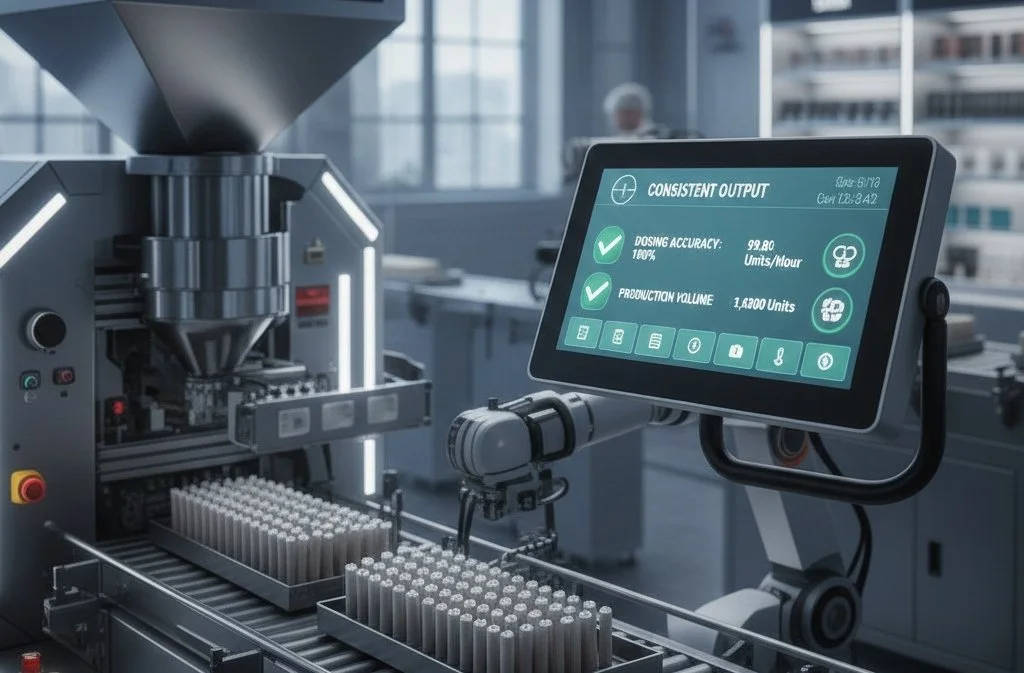
Automated pre-roll production system ensuring consistent output, dosing accuracy, and scalable supply
Automation is often driven by buyer requirements rather than internal efficiency goals. Buyers expect speed, consistency, and scalability that manual processes struggle to deliver reliably. Automated systems stabilize throughput and reduce dependence on variable labor. This predictability makes reordering decisions easier and less risky for buyers.
Throughput Capacity Aligned With Buyer Demand
Buyers expect manufacturers to increase output quickly during promotions, seasonal demand, or sudden sales spikes. Limited capacity or a slow ramp-up can lead to missed sales opportunities. Scalable throughput reassures buyers that supply will keep pace with demand.
SKU Changeover Speed And Flexibility
Fast changeovers allow buyers to test new SKUs, run limited releases, and respond to market trends without disrupting existing inventory. Slow or complex changeovers limit assortment flexibility and reduce buyer willingness to experiment.
Why Does Automation Increase Buyer Confidence?
Because automation delivers consistent output regardless of staffing changes or production volume.
Compliance And Testing Readiness For Buyer Approval
Buyers are highly risk-averse when it comes to compliance. Any product that threatens store licensing, audits, or inspections is quickly deprioritized. Even a single failure can permanently damage trust. Buyers expect compliance safeguards to be built directly into manufacturing systems.
Label Accuracy And Dosing Compliance
Accurate labeling and precise dosing protect buyers from recalls, fines, and consumer complaints. Errors force retailers to pull products from shelves and absorb operational costs. Buyers avoid SKUs with a history of compliance issues.
Track-And-Trace Compatibility Expectations
Buyers expect manufacturers to integrate effectively with state-specific reporting systems. Manual reporting or inconsistent data can increase regulatory risk. Reliable traceability helps reduce compliance issues for both retailers and suppliers.
Why Do Buyers Delist Products After Compliance Failures?
Compliance failures put store licenses, daily operations, and regulatory standing at risk.
Align Production With Buyer Reality To Win Shelf Space
Dispensary buyers ultimately decide which pre-rolls reach consumers and which brands lose shelf access. Manufacturers that align production with buyer expectations, maintain consistent quality, offer predictable pricing, ensure reliable supply, and demonstrate compliance readiness build trust that leads to repeat orders and long-term retail partnerships. Brands that fail to meet these standards are quickly replaced, regardless of marketing or strain quality.
As infused pre-roll demand continues to rise, buyer tolerance for inconsistency is shrinking. Automation-backed manufacturing has become essential for meeting volume, consistency, and margin requirements without increasing operational risk. Facilities that invest in stable, scalable production systems are better positioned to win shelf space and keep it.
If your objective is to protect shelf placement, scale premium SKUs, and secure consistent reorders, your manufacturing strategy must be built around buyer behavior, not internal convenience.
Build pre-rolls that buyers can depend on, and shelf space will follow. Contact us to discuss how your production operation can align with buyer expectations and scale with confidence.
Frequently Asked Questions
What makes a pre-roll manufacturer attractive to dispensaries?
Dispensaries favor manufacturers that deliver consistent product quality, meet delivery commitments, pass compliance reliably, and show steady sell-through across reorder cycles.
How often do dispensary buyers review pre-roll performance?
Most buyers review sales velocity, return rates, and inventory performance monthly, with deeper SKU evaluations conducted quarterly.
Do dispensary buyers prefer local brands or multi-state operators?
Buyers prioritize reliability and performance over brand size or location. A dependable local producer often outperforms a larger brand with inconsistent supply.
Can small pre-roll manufacturers compete with larger brands?
Yes. Small manufacturers can compete effectively by maintaining consistent quality, reliable fulfillment, and predictable pricing that buyers can trust.
Why do dispensary buyers delist pre-roll brands?
Brands are most often delisted due to poor sell-through, inconsistent quality, missed deliveries, pricing instability, or compliance-related issues.