
Unit Economics of Cannabis Automation: When Machines Actually Pay Off
Cannabis automation pays off only when it lowers cost per unit, stabilizes output, and protects margin. If a machine doesn't improve unit economics, it becomes a fixed cost that quietly eats profit.
In cannabis manufacturing, automation isn't a "modernization" badge; it's a unit-level decision shaped by loaded labor cost, throughput limits, compliance exposure, and buyer intolerance for inconsistency. Dispensaries often prefer suppliers who ship on time, maintain stable pricing, and deliver consistent product performance, because reliability reduces shelf risk for buyers.
Manufacturing economics backs this up. McKinsey reports that over the past 30 years, the average robot price has fallen by about half in real terms and even further relative to labor costs, lowering the volume threshold at which automation can earn a return. The remaining question is utilization: will your facility run the asset enough, with low enough downtime, to make those savings real?
In this blog, you'll learn how to calculate breakeven volume, model true cost per unit, and identify the exact conditions where cannabis automation delivers ROI.
What Unit Economics Mean in Cannabis Manufacturing
Unit economics show whether you make or lose money per sellable unit, not per "unit produced." Defects, rework, and failed batches can raise production counts while reducing what actually ships and gets paid for.
That's why unit economics must use a total-cost lens, including equipment, labor, utilities, consumables, maintenance, downtime, and end-of-life, not just the purchase price. An IETC study on industrial energy efficiency also highlights a common blind spot: industrial cooling is often a major electricity-saving opportunity, but it is often ignored due to its complexity and missing operating data. The same pattern appears in cannabis when the cost per unit is calculated without properly allocating utilities, downtime, and scrap.
Cost per Unit in Manual vs Automated Production
Manual workflows can look cheaper early because costs feel variable and easy to control. Over time, they get expensive because labor minutes, supervision, scrap, and overtime rise with SKU complexity and volume pressure. Automation can flatten the cost curve by replacing variable labor time with repeatable machine cycles, but only when utilization is real, changeovers are controlled, and downtime is not eating the hours you assumed you would run. For those seeking high-value SKU production, implementing a Jiko+ hash hole maker system can drastically reduce the manual labor required for complex hash hole joints.
Why Unit Economics Matter More Than Top-Line Growth
Top-line growth without healthy unit economics creates cash pressure. When every added unit carries a weak margin, scaling production can scale losses. Automation earns its place only when it lowers marginal cost as volume rises, so growth becomes margin-positive instead of margin-negative.
How Buyers Indirectly Enforce Unit Economics Discipline
Dispensary buyers prefer stable pricing, predictable fill rates, and consistent product performance. Weak unit economics usually surface as unstable wholesale pricing, missed POs, and inconsistent quality, problems that buyers punish through slower reorders and reduced shelf commitment. Reorder stability is often the fastest real-world test of whether unit economics are actually working.
What is unit economics in cannabis manufacturing?
Unit economics measure the true cost and gross profit per sellable unit, showing whether scaling increases profitability or increases losses. For producers focusing on high-end infusions, using the Jiko pre-roll infusion machine can help maintain potency consistency while supporting lean production costs.
Labor Costs as a Core ROI Driver
In many cannabis operations, labor can become one of the most sensitive cost lines because manual workflows tend to add people and hours as output grows. More units often mean more handling steps, more quality checks, and more opportunities for variation between operators and shifts. When SKUs increase and deadlines tighten, staffing and training demands can become less predictable, putting pressure on margins.
Direct Labor Hours per Unit
Direct labor hours per unit refer to the hands-on time required to produce a sellable unit, including setup, handling, inspection, packaging, and any rework. Automation is typically evaluated on whether it can reduce those minutes without shifting the burden into new tasks such as frequent calibration, intensive cleaning, or constant troubleshooting. In a better-fit setup, the team’s time can shift away from repetitive hand steps and toward monitoring, QA checks, and consistent machine cycles.
Training Turnover and Hidden Labor Costs
Labor cost is often broader than hourly pay. Time spent training, supervising, checking quality, correcting errors, and covering turnover can add "unplanned minutes,” increasing the cost per unit. Automation may reduce reliance on highly consistent hand technique, but it still depends on disciplined SOPs for loading, sanitation, routine checks, and changeovers. When these routines are consistent, performance may become less dependent on individual operator style. Using specialized custom robotics integration and manufacturing design consulting for cannabis helps facilities design these SOPs so that performance becomes less dependent on individual operator style.
Overtime and Surge Demand Penalties
Demand spikes can push manual lines toward overtime or temporary staffing, increasing per-unit costs and introducing greater variability under time pressure. Automation can be assessed by whether it helps absorb volume increases without requiring a proportional rise in labor hours. That outcome generally depends on practical use, transition time, and whether uptime remains stable under real operating conditions.
Why does labor reduction matter so much for roi?
Because many ROI models improve when labor minutes per sellable unit trend downward as volume rises, instead of scaling one-for-one with output.
Throughput and Capacity Utilization Decide Payback Speed

Manual vs automated cannabis production showing throughput, utilization, and cost per unit impact
Automation payback is strongly influenced by utilization because machine costs are largely fixed while output can vary. When a system runs consistently near its practical capacity, fixed cost is spread across more sellable units, which can improve the cost per unit. When a system runs sporadically, the same fixed cost is carried by fewer units, which can weaken unit economics even if the machine performs well during short runs.
Output per Hour vs Output per Shift
Output per hour is a snapshot; output per shift reflects reality. Manual lines can slow down when handoffs increase, errors need correction, or teams rotate. Automated cycles may stay steadier, but shift-level output still depends on cleaning, micro-stops, material staging, changeovers, and staffing coverage. The metric that usually matters is not peak demo speed, but sellable units per shift that meet spec under normal operating conditions.
Volume Thresholds Where Automation Wins
Automation tends to look stronger when the operation reaches a volume at which manual production starts relying on overtime, added headcount, or continuous retraining to maintain quality. The breakeven point varies by facility because it depends on labor rate, waste rate, SKU mix, and the monthly ownership cost of the equipment. The consistent principle is that the machine must replace enough variable cost per unit to justify the fixed monthly cost it adds. For kief-heavy menus, the stardust kief coating machine process becomes the clear winner once a facility produces several thousand units per month.
Matching Machine Capacity to Real Demand
Machine capacity needs to match real demand, not aspirational demand. Oversized equipment can slow payback if orders do not keep the asset loaded, and it can also push teams toward overproduction, increasing inventory risk and handling waste. Right-sized automation usually focuses on the SKUs and volumes that already move consistently, then expands once utilization and changeover discipline are stable.
When does automation usually break even?
When volume is steady enough that the machine runs consistently and replaces a meaningful share of variable labor and waste costs rather than carrying fixed costs while idle.
Quality, Consistency, and Waste Reduction Improve Margins
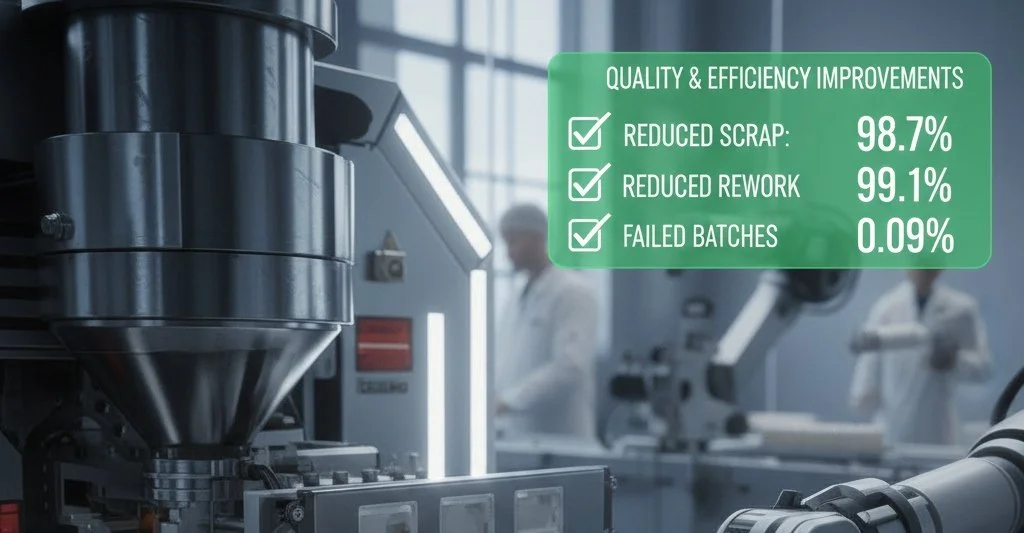
Automated cannabis production reducing waste, rework, and scrap to improve unit economics
Automation affects unit economics beyond speed. Repeatability can affect scrap, rework, and batch stability, thereby changing the number of units that become sellable. When fewer units fall off-spec, a higher share of your inputs can turn into shipped units, lifting margins without relying on price changes.
Reduced Scrap and Rework Rates
Manual work can introduce variation in dosing, placement, handling, and finishing, particularly when materials are sticky, fragile, or sensitive to technique. Automation is often evaluated on whether repeatable cycles reduce off-spec units and the need to rework. When fewer units require correction or disposal, both material loss and labor hours spent on rework can decline.
Testing Failures and Compliance Waste
Testing failures can convert a process issue into a batch-level financial loss. Automation can be assessed on whether it stabilizes critical steps enough to reduce drift that leads to inconsistent results. Even small improvements in process stability can matter if they reduce investigation time, rework burden, or the frequency of products that cannot be shipped as intended.
Predictable Yield Across Batches
Yield predictability supports better planning. When yield is unstable, teams may compensate by running extra production runs, rushing schedules, or increasing inspection, all of which can increase labor and error risk. When yield is more consistent, purchasing, scheduling, and inventory decisions can become more controlled, often resulting in steadier margins rather than a single dramatic cost drop.
How does consistency affect unit economics?
Because fewer defects and fewer failures generally mean a higher share of inputs that turn into sellable units, and fewer labor minutes are consumed by rework.
Comparing Capital Cost & Operating Savings
Automation is a trade between a fixed investment and recurring operating savings. Machines are capital expenses, while labor, waste, rework, and variability are operating expenses that can repeat every shift. The decision typically comes down to whether the savings you can reasonably capture, at the utilization you can realistically sustain, outweigh the monthly ownership cost over the period you plan to run the asset.
Upfront Cost Reality
Upfront costs matter, but they are often judged in isolation. A more decision-ready view compares the full machine cost to the multi-year cost of the manual workflow it is meant to replace, including labor hours, overtime, and the value of material lost to defects and rework. A common mistake is buying equipment before confirming two things: stable demand for sufficient run hours, and a process that is consistent enough to prevent downtime and rework from erasing the gains. It is often wise to seek cannabis robotics consulting services team expertise to run these projections before signing a purchase order.
Ongoing Operating Savings
Operating savings usually show up as fewer labor minutes per sellable unit, fewer defects, lower rework load, reduced material loss on premium inputs, and more stable scheduling that reduces overtime and rush costs. These savings tend to be incremental rather than dramatic, but they can compound because they repeat every production cycle. The goal is consistent savings that persist after ramp-up, not a one-time improvement during the first weeks.
The Time Horizon That Matters
Automation decisions tend to perform better when evaluated over a realistic operating life, with conservative assumptions about ramp-up, downtime, maintenance routines, and changeovers. Short payback expectations can bias teams toward underinvesting in process stability and support, delaying the point at which the machine produces steady, sellable output at a predictable cost.
Why do some automation investments fail to pay off?
Because utilization stays low, downtime and changeovers consume more hours than planned, or the machine does not replace enough variable labor and waste cost to justify the fixed monthly ownership cost.
When Cannabis Automation Does NOT Pay Off!
Automation is not universally beneficial. It fails when demand is inconsistent, processes are not standardized, or the purchase is driven by optics instead of economics.
A cleaner way to avoid bad buys is to model conservative utilization, downtime, and changeover time, then see whether the unit economics still improve.
Low and Inconsistent Production Volume
If demand is sporadic, machines sit idle, and the fixed monthly cost cannot be diluted. In that scenario, manual production or outsourcing often remains economically cleaner until volume stabilizes.
Poor Process Definition Before Automation
Automating a broken process scales the problems. If inputs are inconsistent, SOPs are weak, or QA gates are unclear, a machine can increase speed while increasing defect volume. Automation should follow process clarity, not substitute for it.
Buying Machines for Marketing, Not Economics
If the machine is purchased to “look advanced” rather than to eliminate a measurable unit-level cost, it usually disappoints financially. The economics must be proven at the SKU level with conservative demand and real workflow constraints.
When should manufacturers delay automation?
When demand is unstable or processes are not standardized enough to produce repeatable output, utilization will be low.
Signs Automation Will Pay Off in Your Operation
Automation usually makes sense when manual production becomes a structural limit, not a short-term staffing problem. The clearest signals show up in unit economics, daily scheduling pressure, and the gap between what you can produce and what the market expects you to deliver consistently.
The Cost Signals That Usually Show Up First
A strong case starts to form when overtime becomes routine, labor minutes per unit trend upward, and rework becomes a normal part of the schedule rather than an exception. Another signal is when material loss and scrap are no longer "small fixes" but regular margin drains, especially on premium inputs. Compliance-related holds, failed batches, or repeated investigation cycles can also form a pattern in which one bad run wipes out the profit from several good runs.
The Commercial Signals Buyers Send
Buyer behavior often reflects production economics faster than internal reporting. When accounts start asking for tighter delivery windows, more consistent volume, and stable pricing, they are indirectly forcing process stability. If inconsistent quality causes slower reorders, smaller POs, or pricing pushback, it usually means your operation is being judged on reliability, not effort. When manual systems struggle to meet those expectations without cost spikes, automation can start to look like a margin-protection move rather than a luxury.
What are the clearest signs automation will pay off?
Rising labor minutes and overtime, repeatable quality issues, growing rework load, and steady buyer demand for volumes that manual production struggles to fulfill profitably.
Automation Pays Off Only When It Improves Unit Economics
Cannabis automation pays off only when it lowers cost per unit, stabilizes output, and protects margin at scale. Machines that replace variable labor, reduce waste, and improve repeatability can become profit centers over time by reducing cash leakage from overtime, scrap, and rework.
If your operation is reaching the limits of manual production, the question is no longer whether automation is expensive. The real question is how much manual inefficiency is already costing you every month.
To get a clear, decision-ready picture, build a one-page unit economics model for your top SKUs using loaded labor, waste dollars, and realistic utilization. Then validate those assumptions with a pilot run and a machine demo to see if your breakeven volume aligns with your goals.
Take the next step with Sorting Robotics: explore our Jiko and Jiko+ pre-roll infusion systems, Stardust kief coating machines, and custom automation solutions to reduce labor, improve consistency, and maximize throughput. Schedule a consultation or demo to map your unit economics and see how our machines can turn your production challenges into measurable ROI.
Frequently Asked Questions
What is the best single metric to track weekly after installing automation?
Track cost per sellable unit alongside scrap dollars, because speed without sellable yield can hide losses.
How should changeover time be priced in the ROI model?
Price changes are planned downtime, measured as lost contribution margin per hour, because the economic loss is the margin you could have produced.
Does automation require a full-time technician to be profitable?
Not always, but you must budget time for preventive maintenance, calibration checks, and basic troubleshooting, or uptime will collapse ROI.
How do you fairly compare automation ROI across different SKUs?
Normalize by using the same unit definition (for example, per 1,000 sellable units) and include SKU-specific waste, rework, and changeover time.
What is the most common ROI mistake teams make with automation demos?
They use the best-case demo speed rather than the shift-average sustained throughput that accounts for normal cleaning, changeovers, and operator rotation.