
How to Future-Proof Your Cannabis Facility Against Regulatory Changes
Regulations in the cannabis industry shift faster than almost any other consumer product sector. What keeps your facility compliant today might leave you scrambling for costly upgrades tomorrow. One month, you are operating smoothly under current state guidelines; the next, a new packaging requirement or safety standard forces a complete overhaul of your production line.
Future-proofing your cannabis facility means building operational systems, documentation practices, and equipment infrastructure that can adapt as laws evolve. According to a 2023 survey by Whitney Economics, only 24.4% of U.S. cannabis operators reported being profitable, down from 42% the previous year, with strict regulatory rules, taxes, and lack of access to capital cited as primary drivers of this crisis.
To survive these pressures, operators must invest in scalable automation, pursue certifications like cGMP before they become mandatory, and design facilities with inherent flexibility.
This article breaks down the strategies cannabis operators are using to stay ahead of regulatory changes, protect their licenses, and position their facilities for long-term success.
Understanding the Current Regulatory Landscape in Cannabis
To build a resilient facility, you first need to understand the forces driving the constant state of flux in our industry. Unlike established sectors where rules have been static for decades, cannabis is navigating a complex transition from prohibition to legalization, creating a unique regulatory environment that requires constant vigilance.
Why Cannabis Regulations Change More Often Than Other Industries
The cannabis industry is operating in a unique historical moment. Because it remains federally illegal while being legal in various capacities across dozens of states, there is no single, unified standard. State agencies are effectively building the plane while flying it, often reacting to public health concerns, political shifts, or unforeseen market dynamics with immediate rule changes.
In mature industries like alcohol or pharmaceuticals, regulatory frameworks were solidified decades ago. In cannabis, that timeline is compressed. We are seeing 50 years of regulatory evolution in 5. This rapid maturation means that what passes inspection in Q1 might be a violation by Q4. Operators who assume the current rulebook is permanent are the ones most vulnerable to disruption.
Federal Rescheduling and What It Means for Your Facility
The potential move from Schedule I to Schedule III, underscored by the 18 December 2025 Executive Order directing the Attorney General to expedite the process, represents the single biggest regulatory shift on the horizon. While the reclassification would confirm eligibility for federal tax deductions under Section 280E, its operational implications are equally profound.
A detailed legal analysis by the Congressional Research Service warns that Schedule III status does not automatically validate state-legal recreational operations; rather, it positions marijuana as a substance requiring FDA approval for prescription use.
This opens the door for strict federal regulation under the Food, Drug, and Cosmetic Act, where manufacturers would likely need to register with the DEA and meet pharmaceutical-level compliance standards.
If the FDA steps in, the industry will see a rapid standardization of manufacturing practices. Facilities that are currently "good enough" for state inspectors may fall short of federal requirements for pharmaceutical manufacturing. Many operators are turning to custom robotics integration and manufacturing design consulting to ensure their layouts can handle these tightening constraints.
This could include stricter mandates on labeling accuracy, adverse event reporting, and facility registration. Operators who begin aligning their facilities with federal expectations now will have a significant head start, avoiding the panic of trying to retrofit a facility overnight once rescheduling occurs.
State-by-State Variance and the Multi-State Challenge
For Multi-State Operators (MSOs), the lack of federal standardization creates a massive logistical headache. A compliant facility design in California might fail inspection in Illinois. California enforces strict environmental and energy-use rules, while Illinois emphasizes security and social equity provisions. Colorado, meanwhile, has specific perimeter security standards that differ from the East Coast markets.
This patchwork means you cannot simply copy and paste a facility design from one state to another. However, you can standardize your internal processes. Successful MSOs build their SOPs and equipment choices around the strictest common denominator. When you scale cannabis business robotic packaging, you create a system that is inherently more compliant with high-level safety standards across multiple regions.
By designing your facility to meet the most rigorous standards in your portfolio, you ensure that your operations are compliant everywhere, simplifying management and training across jurisdictions.
Does federal rescheduling automatically void conflicting state regulations?
No. It creates a dual-layer system. State rules often serve as the baseline for licensure and retail, while federal rules add a layer of oversight, particularly for medical claims and manufacturing standards. You will likely need to satisfy the stricter of the two frameworks.
Building a Compliance-First Culture in Your Cannabis Operation

Equipment and facility layout are critical, but they are useless without the right culture. Compliance is ultimately a human behavior. Building an organization that prioritizes adherence to standards ensures that your expensive infrastructure is used correctly and that your license remains safe.
Developing Standard Operating Procedures That Flex with Regulations
Your Standard Operating Procedures (SOPs) are the backbone of your compliance program. In many facilities, SOPs are static documents gathering dust in a binder. To future-proof your operation, your SOPs must be living documents.
Effective SOPs need built-in mechanisms for version control and rapid approval workflows. When a regulation changes - for example, a new state requirement for labeling font size - you need a process to update the relevant SOP, get it approved by management, and disseminate it to the floor immediately.
This aligns with the mission of ASTM International Committee D37 on Cannabis, which was formed to address quality and safety through the development of voluntary consensus standards across areas such as quality assurance and packaging.
Furthermore, using automation systems with customizable parameters makes these shifts easier. If a dosing limit changes, updating a recipe profile on a robot like the Jiko automated infusion system is significantly faster and more reliable than retraining staff to manually weigh a different amount.
Training Programs That Keep Your Team Audit-Ready
Even the best SOPs fail if employees aren't trained on them. Regulatory bodies are increasingly focusing on training records during inspections. They want to see proof that every employee who touches the product has been trained on the specific task they perform and that their competency has been verified.
A future-proof training program relies on digital tracking. You should know exactly which employees are certified for which machines and when their certifications expire. When a regulation changes and an SOP is updated, your system should automatically flag that retraining is required. This level of organization protects your license during inspections and, more importantly, reduces the risk of human error that leads to compliance violations.
Documentation Practices That Protect Your License
In the eyes of a regulator, if it isn't documented, it didn't happen. Batch records, cleaning logs, equipment calibration records, and Corrective and Preventive Actions (CAPA) are not administrative annoyances; they are your primary defense.
Future-proofing means moving away from handwritten logs, which are prone to illegibility, loss, and falsification errors. Automated systems that generate digital audit trails reduce your team's paperwork burden while improving accuracy. When an auditor asks to see the cleaning logs for a specific machine from six months ago, being able to pull that record instantly sends a strong signal of competence and control.
How often should SOPs be reviewed if no regulations have changed?
Annual reviews are best practice. Even without legal changes, process drift occurs where employees find shortcuts that may not be compliant. Regular reviews ensure your written procedures match the actual workflow on the floor and remain audit-ready.
Investing in Scalable Automation for Long-Term Compliance
Automation is often sold as a labor-saving tool, but its role in compliance is arguably more valuable. Robots do not get tired, they do not misread a scale, and they do not forget to log a data point. Integrating systems like those from Sorting Robotics transforms compliance from a manual effort into an automatic outcome.
How Automation Reduces Human Error in Regulated Processes
Human error is the leading cause of compliance deviations in manufacturing. In manual pre-roll production, for instance, variances in flower weight or infusion dosage are common. A worker might over-infuse one joint and under-infuse the next, leading to potency testing failures or, worse, a product recall.
Robotic systems address this by delivering precision dosing, consistent output, and repeatable results that satisfy regulatory requirements. Whether it is injecting concentrate or coating a pre-roll with kief using the Stardust system, automation ensures that the physical product matches the specifications filed with the state. This consistency is crucial for passing testing hurdles and maintaining the trust of regulators, who view variances as signs of poor process control.
Real-Time Production Data and Audit-Ready Reporting
Modern automation does more than move product; it generates data. A fully automated line tracks throughput, batch data, and production metrics in real time. This capability is essential for modern compliance.
Instead of waiting for end-of-day reports to spot discrepancies, operators can see production data as it happens. This allows for immediate course correction. When an audit occurs, having a robotic system that automatically logs every gram of oil used and every unit produced simplifies the process immensely. You are no longer scrambling to reconstruct production runs from scattered paper notes.
Choosing Equipment That Adapts to Changing SKU Requirements
Regulations often impact what products you are allowed to sell. States may suddenly impose potency caps, ban certain additives, or change packaging requirements. If your production line is rigid, these changes can render million-dollar investments obsolete.
Future-proofing requires choosing modular automation systems. You want equipment that supports interchangeable components and customizable profiles. If the market shifts from 1-gram pre-rolls to 0.5-gram "dogwalkers" due to tax changes or consumer preference, your equipment should be able to pivot with a simple tooling change rather than a full replacement. Custom integrations and flexible robotics enable you to adapt to new SKU requirements without halting operations for months of retooling.
Can legacy automation equipment be retrofitted for new compliance standards?
Often, it is cost-prohibitive. Older "black box" systems frequently lack the open APIs needed for modern real-time data integration, making modular replacement a smarter long-term investment. Modern compliance requires data visibility that legacy hardware simply wasn't built to provide.
Pursuing Certifications Before They Become Mandatory
Waiting for a certification to become a legal requirement is a risky strategy. By the time it is mandated, the backlog for consultants and auditors will be months long, and you will be fighting for survival rather than leading the market.
cGMP Certification as a Pathway to Federal Readiness
Current Good Manufacturing Practice (cGMP) is the gold standard for manufacturing quality. While not yet universally required in every state, it is the standard the FDA enforces for food and pharmaceuticals. If and when federal rescheduling occurs, cGMP will likely become the baseline requirement for cannabis manufacturing.
cGMP is not just about cleanliness; it is a holistic system covering facility design, equipment maintenance, personnel training, and document control. Obtaining cGMP certification now positions your facility as federal-ready. It also opens doors to international markets like Germany or Australia, which strictly require GMP certification for imported medical cannabis products.
GACP Standards for Cultivation Operations
For cultivators, the equivalent standard is Good Agricultural and Collection Practices (GACP). This framework covers everything that occurs before the drying stage: site selection, water source quality, pesticide use, harvesting, and post-harvest handling.
Once the plant is harvested and begins drying, GMP standards typically come into effect. Implementing GACP ensures that your raw materials are compliant before they even enter the manufacturing stream. It minimizes the risk of heavy metal contamination or pesticide residue failures, which are among the most common reasons for costly crop destruction orders.
Understanding the Cost and Timeline for Certification
It is important to be realistic about the investment required. Achieving cGMP or GACP certification is not a cheap or quick process. Costs can range from tens of thousands to hundreds of thousands of dollars, depending on the size and complexity of your facility and the amount of remediation needed.
The timeline is equally substantial, often taking 6 to 12 months from the initial gap analysis to the final audit. However, the ROI is clear. Beyond regulatory requirements, certified facilities often command higher valuations, secure better insurance rates, and gain access to shelf space with major retailers that prioritize supply chain safety.
Is ISO 9001 certification a substitute for cGMP in cannabis?
No. ISO 9001 focuses on general quality management systems, whereas cGMP focuses on product safety and manufacturing consistency. While helpful, ISO alone will not satisfy FDA-level scrutiny or international import requirements, which specifically demand GMP.
Designing Facilities for Regulatory Flexibility
The physical walls of your facility are harder to move than a machine. Decisions made during the design phase will dictate your ability to adapt for years to come.
Modular Layouts That Support Future Expansion
Rigid floor plans are the enemy of adaptability. A future-proof facility uses modular layouts that enable reconfiguration. This means avoiding permanent, load-bearing walls between production zones where possible, opting instead for cleanroom paneling or modular partitions.
When planning electrical and plumbing systems, build in excess capacity. If a new regulation requires additional air filtration or you decide to add a new automated line, having the electrical drops and HVAC capacity already in place saves you from expensive, disruptive construction projects. Leaving physical space for growth reduces the complexity of future expansions, allowing you to scale up without shutting down.
Environmental Controls and Air Quality Compliance
Environmental regulations are tightening, particularly regarding odors and volatile organic compounds (VOCs). Local municipalities are becoming less tolerant of cannabis odors, and air quality permits are becoming harder to obtain.
Your HVAC and air filtration systems should be designed to exceed current standards. A life cycle assessment published in Nature Sustainability quantified the environmental impact of indoor cultivation, revealing that greenhouse gas emissions can range from 2,283 to 5,184 kg of CO2-equivalent per kg of dried flower, largely driven by electricity and natural gas consumption for environmental controls.
Scalable HVAC systems can accommodate new regulations around emissions without requiring a total facility overhaul. Investing in robust odor mitigation technology now prevents friction with the community and local government later - a common source of license revocations.
Security Infrastructure That Exceeds Current Requirements
Security requirements are another area of frequent change. States often update rules regarding video retention times, camera resolution, or access control logs.
Building a security infrastructure that barely meets today's minimums is a recipe for future expense. Install high-resolution cameras, ensure your server storage can handle longer retention periods than currently mandated, and implement biometric or keycard access controls that log every entry and exit. When regulators inevitably tighten these rules, you will already be compliant, while your competitors scramble to upgrade their hardware.
What is the most common facility design flaw that causes compliance issues?
Inadequate separation of processes. Failing to physically separate "clean" and "dirty" zones creates cross-contamination risks that are difficult to address without major construction. Future-proof designs prioritize logical process flow to prevent material crossover.
Implementing Robust Track-and-Trace Systems
At the heart of cannabis compliance is traceability. If you cannot prove where every gram of material came from and where it went, you are not compliant.
Integrating Automation with Metrc and BioTrack
State-mandated systems like Metrc and BioTrack are non-negotiable. However, manual data entry into these systems is a major source of error. Transposing a number or mistyping a batch ID can trigger an investigation.
The solution is integration. Advanced automation and ERP systems can "talk" directly to Metrc or BioTrack via API. This means that when a production run is complete, the data is automatically uploaded. This seamless integration ensures real-time visibility and significantly reduces the labor hours dedicated to compliance data entry.
Batch Traceability from Raw Materials to Finished Goods
True traceability goes beyond the state system. You need internal chain-of-custody documentation that tracks a batch from raw flower to oil to infused pre-roll to final packaging.
Automation systems that track batch data throughout the production process create the granular audit trail regulators require. In the event of a product recall - whether voluntary or mandated - this level of detail allows you to isolate exactly which units are affected. You can recall specific batch numbers rather than destroying weeks of production, saving immense capital and avoiding reputational damage.
Using Production Data to Anticipate Compliance Issues
Compliance shouldn't be reactive. By analyzing data from your track-and-trace and automation systems, you can spot trends before they become violations.
For example, if you notice a gradual drift in the fill weight of your pre-rolls, you can recalibrate your equipment before you start producing non-compliant units. Monitoring yield variances can help identify potential diversion or process inefficiencies. Proactive monitoring via analytics dashboards is far more cost-effective than reactive remediation after a failed inspection.
What happens to compliance data if the facility loses internet access?
Robust automation systems use "store and forward" technology. They cache data locally during outages and automatically upload it to state systems like Metrc once connectivity is restored, ensuring no data gaps appear in your regulatory reporting.
Preparing for OSHA and Workplace Safety Requirements
While most operators focus on cannabis-specific regulations, OSHA (Occupational Safety and Health Administration) compliance is becoming a major priority. As the industry normalizes, federal worker safety standards are being applied more rigorously.
Extraction Lab Safety and Hazardous Material Handling
Extraction facilities face the highest scrutiny due to the use of volatile solvents like butane and ethanol. Fire safety requirements here are non-negotiable. This includes fire-rated rooms (C1D1/C1D2), explosion-proof equipment, and comprehensive ventilation systems.
Beyond the infrastructure, you must have rigorous Hazard Communication (HazCom) standards in place. Employees need to know exactly what chemicals they are handling, have access to Safety Data Sheets (SDS), and use the correct Personal Protective Equipment (PPE).
Ergonomics and Repetitive Motion Protections
A less obvious but increasingly cited OSHA issue in cannabis is repetitive strain injury. Manual trimming, rolling, and packaging are repetitive tasks that can lead to carpal tunnel and other musculoskeletal disorders.
This is another area where automation protects your business. By shifting these repetitive tasks to machines - such as using robots for packaging or infusion - you reduce the physical strain on your workforce. This not only lowers your workers' compensation risk but also improves employee retention and morale.
Building a Safety Documentation System That Satisfies Inspectors
OSHA runs on documentation. If an inspector walks in, they will ask for your safety training records, incident reports, and hazard assessments.
A future-proof facility maintains a centralized safety documentation system. Every accident, near-miss, and safety meeting should be logged. Regular internal safety audits should be conducted and documented. Comprehensive documentation is your best defense against citations and fines, proving that you are actively managing a safe workplace.
Does federal illegality exempt cannabis facilities from OSHA inspections?
Absolutely not. OSHA is a federal agency that protects worker safety regardless of the industry's legal status. They actively inspect and fine cannabis operations for safety violations, particularly regarding fire hazards and respiratory protection.
Building a Facility That Thrives Through Regulatory Change
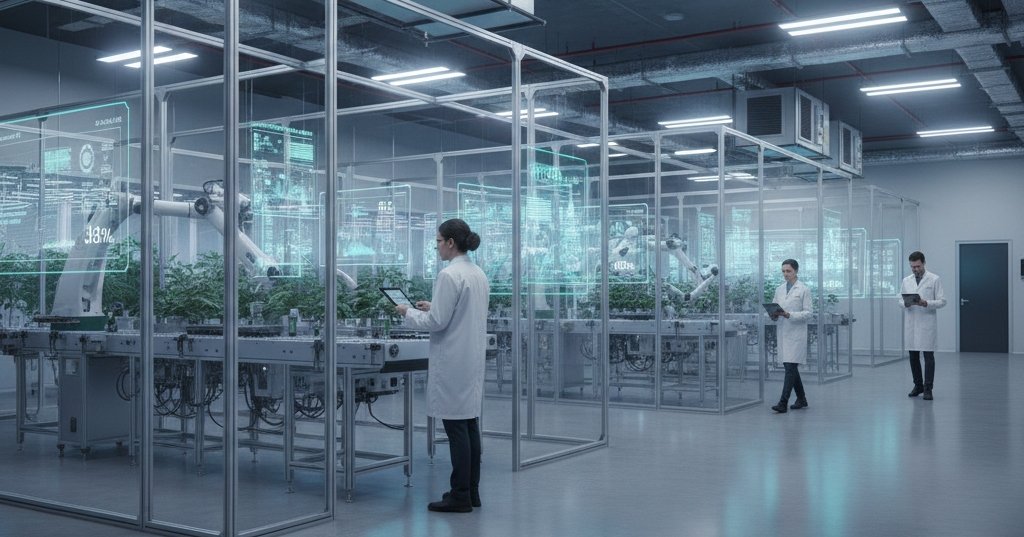
Change is the only constant in this industry. The operators who thrive are not necessarily the ones with the most capital, but the ones with the most adaptability.
Future-proofing is a strategic mindset. It requires flexible infrastructure, scalable automation for precision and repeatability, and proactive certifications like cGMP. By making these investments today, you buy peace of mind. When regulations shift, your facility will be ready to capitalize while competitors play catch-up.
The future of cannabis belongs to the prepared. Evaluate your vulnerabilities today and discover how Sorting Robotics can strengthen your compliance posture. Visit Sorting Robotics to explore automation solutions that keep you ahead of the curve.
Frequently Asked Questions
What is the role of a designated Cannabis Compliance Officer?
A dedicated Compliance Officer acts as the primary firewall between your operations and regulatory penalties. Unlike a general manager, their sole focus is on monitoring changes to state and federal laws, updating internal SOPs, and conducting regular internal audits. They are responsible for ensuring that the gap between "written procedure" and "floor practice" never widens to the point of a violation.
How strict are cannabis waste disposal regulations?
Extremely strict. In most jurisdictions, cannabis waste cannot simply be thrown in a dumpster. It must be rendered "unusable and unrecognizable," typically by grinding it and mixing it with at least 50% non-cannabis waste (like cardboard or soil) before disposal. Every step of this process must be logged, weighed, and often witnessed on camera to prevent diversion.
What are the most common reasons for cannabis license suspension?
While major crimes grab headlines, most suspensions stem from administrative failures. The most common triggers include inventory discrepancies in the track-and-trace system (diversion), failure to maintain proper security camera coverage/retention, and selling products to minors (often due to lax ID checks).
How long does a cannabis facility need to retain video surveillance footage?
This varies significantly by state, typically ranging from 30 to 90 days of continuous footage. To future-proof your security, it is best practice to invest in cloud-based storage with 90-day retention, ensuring you meet the minimum requirements of most jurisdictions and are protected against sudden rule changes.
What is a "mock recall" and how often should we conduct one?
A mock recall is a practice drill where you test your ability to trace a specific batch of product from finished sale back to the original seed. Regulatory bodies expect you to produce these records within hours, not days. Conducting a mock recall quarterly proves your traceability systems are working and prepares your team for the real thing.