Why Modular Automation Reduces Capital Risk for Cannabis Startups
Cannabis startups operate in a high-stakes environment where premature, "all-in" automation is often a terminal mistake. Competitors may commit huge sums to full-scale production lines, but pouring seed capital into inflexible infrastructure before establishing reliable unit economics drains essential liquidity.
According to a report by Whitney Economics, only 24.4% of cannabis operators in the U.S. are profitable, highlighting that financial discipline, not just capacity, is the primary determinant of survival. Too many operations fail by overspending on rigid systems that require high throughput just to break even, leaving no runway to pivot when consumer demand changes.
Successful operators prioritize capital efficiency and operational agility by building capacity incrementally through modular automation. Unlike "big bang" installations, modular systems solve specific bottlenecks, such as product scalability or coating consistency, immediately while preserving working capital. Each unit pays for itself before the next investment, ensuring funds drive actual growth rather than depreciating in underutilized assets.
This guide demonstrates why modular automation offers a safer path to growth, detailing how phased implementation protects runway and signals operational maturity to investors.
The Capital Challenge Cannabis Startups Actually Face
To understand why modular automation is the defensive move your balance sheet needs, you must examine the unique financial pressure cooker of the cannabis industry. Unlike standard manufacturing, where equipment loans are accessible and paid off over years, cannabis operators face a distinct cash crunch.
Banking and Financing Roadblocks
Federal banking restrictions create a severe barrier to capital, leaving traditional financing often unavailable for plant-touching businesses. Operators typically cannot walk into a major bank to finance a $500,000 production line at prime rates, and even when debt financing is available, interest rates are often punishing.
Reporting from the Los Angeles Business Journal indicates that interest rates for private cannabis financing typically range between 15% and 25%, significantly higher than the single-digit rates available to mainstream industrial sectors.
This makes private capital your primary lifeline. Whether it comes from angel investors or early-stage VC, that money is expensive. Every dollar you spend on Capital Expenditures (CapEx) is a dollar you cannot spend on licensing, compliance, or market penetration. Burning cash on massive fixed assets without getting an immediate return creates a liquidity trap that is difficult to escape. Many founders find success by scaling cannabis business to manage these costs effectively.
The Labor Cost Squeeze
Manual production bleeds operational cash because labor costs frequently consume 30% to 50% of operational budgets in manual facilities. Hiring is competitive, and retention is a constant struggle. Training staff to hand-roll or infuse joints takes time, and turnover disrupts production schedules instantly.
Every manual process is a compounding expense that eats into your margins. Expenses include headcount, payroll taxes, benefits, and the inevitable cost of human error, such as weight variance, wasted concentrate, and inconsistent burn rates. Staying manual burns cash on daily operating costs (OpEx), yet the cost of full-line automation is often too high. This is the efficiency gap that many startups fail to overcome. which is why they often look to reduce labor costs to stabilize their bottom line.
Market Volatility and Price Compression
Cannabis pricing compresses as markets mature. Products that command premium pricing today will likely compete strictly on cost tomorrow. If you engineer a facility to produce a $20 pre-roll at scale and the market price drops to $12, your margin assumptions collapse.
Large fixed investments increase your risk in a tightening market. If you commit all your capital to a rigid system designed for one specific product type, you are exposed. Startups need operational flexibility to pivot. If consumer demand shifts from 1-gram joints to 0.5-gram dogwalkers, or from distillate to solventless hash holes, your infrastructure must adapt. Rigid automation becomes "dead capital" in a shifting market.
The Automation Timing Problem
The dilemma is sharp: investing in automation too early ties up capital that would otherwise be used for inventory, but waiting too long means competitors outpace you on unit costs. Precision timing separates the operators who scale from those who stall.
This timing problem is exactly why the modular approach has become the standard for engineering-focused operators.
Modular Automation vs. All-In Automation: Two Different Playbooks
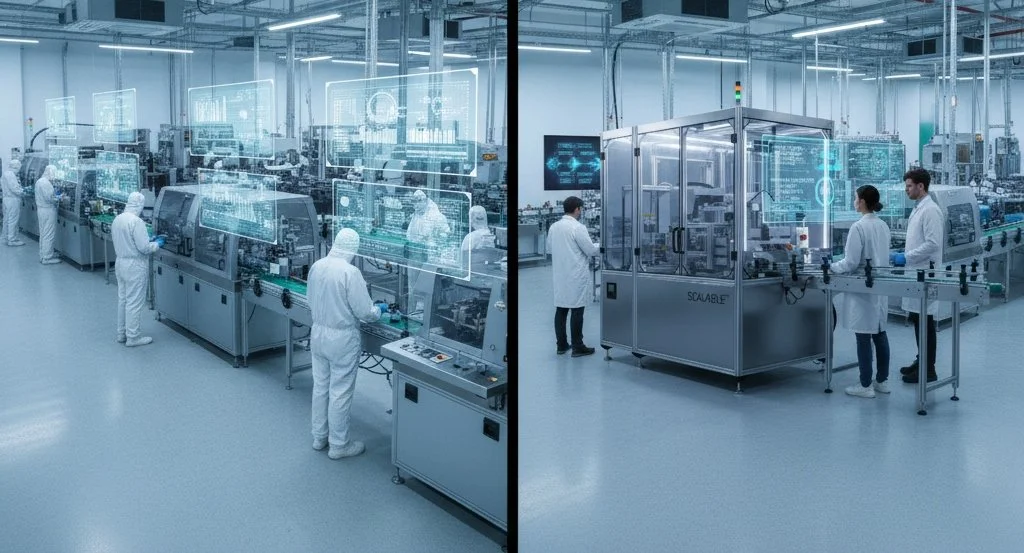
There are two distinct engineering approaches to the production floor. One looks impressive in a pitch deck but is operationally fragile, while the other builds robust, scalable capacity.
The All-In Approach and Its Hidden Costs
The "big-bang" model involves purchasing a fully integrated, end-to-end line: grinding, filling, packing, twisting, weighing, and labeling. It requires massive upfront capital, often demanding a 50% deposit before fabrication even begins.
The hidden costs here are implementation delays and rigidity, as these systems have long lead times, which lock up capital for months. Commissioning takes weeks, and crucially, these systems are designed for maximum capacity. If you use only 20% of the machine's throughput, your cost per unit skyrockets because you are paying for the depreciation of the entire line while using only a fraction of it.
This was evident during the early Canadian legalization rush, when massive facilities built with equipment designed for theoretical capacity never materialized, leading to the destruction of millions of pounds of unsold product. MJBizDaily reported that over 1.7 billion grams have been destroyed since 2018, and that equipment will eventually be sold for pennies on the dollar.
What Modular Actually Means
Modular automation is the smarter engineering alternative because it involves deploying individual machines that operate independently while retaining the ability to integrate into larger systems. Each module now targets a specific production bottleneck.
For instance, if your team is proficient at rolling but inefficient at infusing, hand-injecting distillate introduces mess, inaccuracy, and weight variance. Replacing the rolling team is unnecessary; instead, you deploy a Jiko infusion robot.
This single move engineers out the infusion bottleneck. You produce infused SKUs with precision dosing, enabling a premium product line that pays for the machine. As volume grows, you add a pre-roll kief coating machine like the Stardust, and later, you automate cone filling.
Why Flexibility Beats Raw Capacity
Equipment bought for current trends can become obsolete rapidly. Modular systems offer adaptability because you can swap a component without scrapping the entire line. If the market shifts from distillate to rosin, your infusion module may need calibration, but your packaging and labeling modules remain active.
Modular systems scale throughput based on actual demand. If you secure a white-label contract, you add a module to double throughput on that specific process. You avoid the risk of a monolithic system that requires massive volume to justify its existence.
Do modular systems create disconnected workflows that hamper efficiency?
No, properly engineered modular systems operate as cohesive units that simply buffer. Research from Deloitte on smart manufacturing indicates that modular, flexible production lines can increase capacity by up to 25% compared to traditional lines by reducing the impact of downtime; if one station pauses, upstream and downstream processes continue via buffers, increasing overall line availability (OEE).
Five Ways Modular Automation Protects Startup Capital
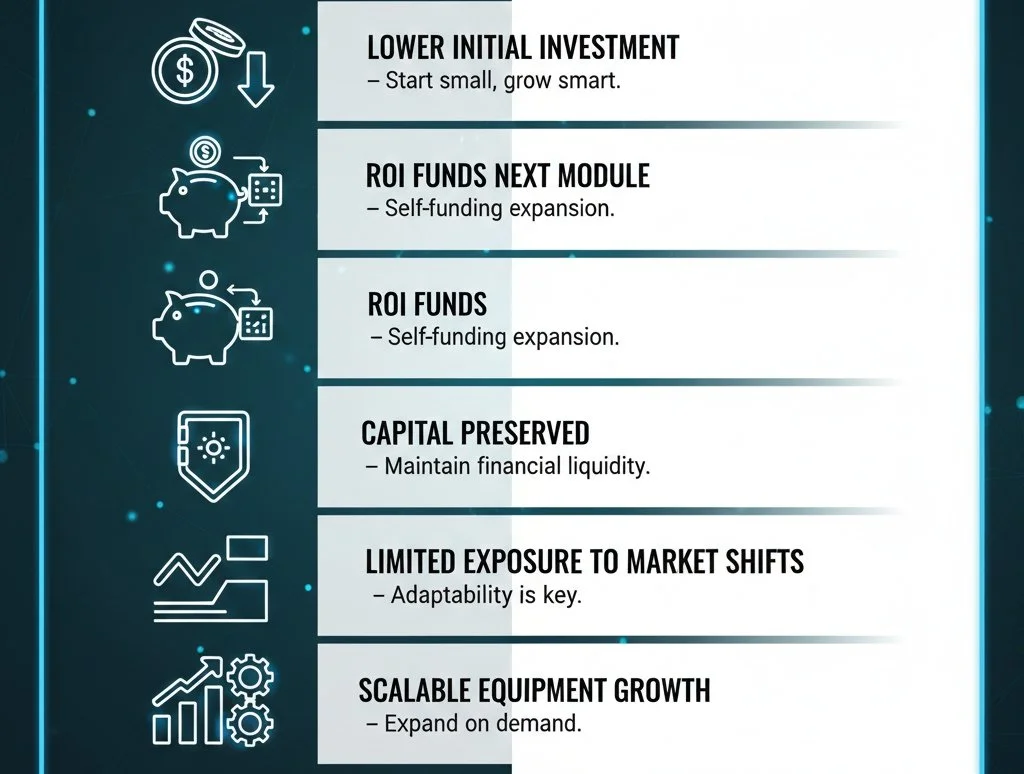
Protecting your runway is the top priority. Here is how a modular approach preserves cash flow while enabling scale:
Lower Initial Investment, Faster Launch: Startups can deploy a single machine targeting their highest-volume SKU for a fraction of the cost of a full line ($30k–$100k vs. $500k+). This allows facilities to be operational in weeks, enabling them to move from 500 to 2,000 daily units immediately.
Revenue Funds the Next Investment: Targeted investments deliver faster ROI (often 6–12 months). Savings from the first module fund the down payment on the next, allowing you to build a factory based on operational efficiency rather than diluted equity.
Capital Stays Available for Opportunities: By avoiding rigid machinery lock-in, you preserve working capital to react to market shifts, whether that's a new state opening for licensing or a drop in bulk flower prices.
Limited Exposure When Markets Shift: Modular systems allow for re-configuration. If a specific SKU category declines, you have only risked the capital for that one module, not the entire production floor.
Equipment That Grows With the Operation: Industrial-grade modular systems are designed for "plug-and-play" integration. Your investment in year one remains productive in year five, performing as part of a larger, integrated system rather than becoming obsolete.
Is the total cost of ownership higher when buying modules piecemeal?
While individual units may lack a bulk-purchase discount, the savings from not committing funds upfront, plus the avoidance of paying for unused capacity, typically make the phased approach cheaper in the long run. You avoid paying interest or giving up equity for capacity you do not yet need.
A Practical Framework for Automation Timing
Automation is not a luxury; it is a math problem. The following table provides a strategic framework for investment timing based on your current production volume.
| Production Volume | Operational Focus | Strategic Action |
|---|---|---|
|
Small Scale (Under 10k Units/Mo) |
Process Refinement & Market Fit |
Manual production is viable, but consistency is the variable.
Differentiation via Quality: Target a single machine for your highest-margin SKU (e.g., Jiko) to guarantee precision. Use automation for Quality Assurance rather than just throughput. |
|
Medium Scale (10k–50k Units/Mo) |
Eliminating Labor Bottlenecks |
Manual processes now cap growth.
Swap Labor Costs for Assets: Target processes consuming the most labor (e.g., twisting/weighing). Aim for a 30–50% labor cost reduction per unit. Returns here fund further expansion. |
|
High Volume (50k+ Units/Mo) |
Integrated Throughput |
Small inefficiencies now cost thousands monthly.
Competitive Moat: Connect modules (e.g., Jiko+ → Stardust) with custom integrations for data tracking and QC. This establishes a high-barrier competitive advantage. |
Decision Factors to Evaluate
Use this checklist to determine if you are ready to evaluate a module. Hitting any of these markers signals an immediate opportunity:
Labor Cost > 35% of Production Costs: Your labor expenses are eating into potential equipment ROI.
Quality Consistency: Returns or rejections are impacting brand reputation and retail relationships.
Throughput Bottleneck: A single step, such as infusion or closing, is limiting the line's output.
Unfulfilled Demand: You are turning down orders because of capacity constraints.
Competitive Pressure: Automated competitors are undercutting your price while maintaining or exceeding your product specs.
How should seasonal demand fluctuations influence automation timing?
Automating for average demand rather than peak demand preserves capital. During seasonal peaks (like "Croptober"), operators can run additional shifts on modular equipment rather than purchasing excess capacity that sits idle for the rest of the year. This maximizes the value you get from your equipment compared to sizing a full line for a once-a-year peak.
How Smart Automation Builds Investor Confidence
Investors scrutinize operational discipline. They are wary of "build it and they will come" models and demand capital efficiency instead.
What Cannabis Investors Actually Look For: VC and PE firms prioritize scalability and solid unit economics (profit per item). Operations that burn funding on equipment that never reaches capacity are red flags. Demonstrated ROI from initial automation validates operational maturity.
Phased Investment as a Credibility Signal: Modular automation demonstrates that founders understand capital allocation. Each investment has a clear thesis and metrics where returns inform subsequent decisions, separating fundable companies from money pits.
Production Data as Due Diligence Fuel: Automated systems generate data that manual operations cannot. Providing investors with logs stating "99.5% uptime and waste under 2%" streamlines due diligence and builds confidence.
Scalability Without Immediate Capital Needs: Modular systems provide a clear path to growth (e.g., "add two modules to triple output") without requiring immediate, massive funding to prove it.
Do investors prefer proprietary custom-built machinery or standardized modular systems?
Investors increasingly favor standardized, proven modular systems over custom "black box" engineering. Standard equipment represents a liquid asset with resale value and verifiable support, whereas custom machinery is often viewed as a liability if the primary engineer leaves or if the "one-off" prototype fails.
The Capital-Efficient Path to Scale
You do not need MSO-level funding to deploy world-class manufacturing. Modular automation empowers startups to scale production without betting the company because each investment proves its ROI before the next commitment. Capital remains liquid while operations improve sustainably.
Operational efficiency separates winners from casualties as markets mature. Startups building infrastructure thoughtfully position themselves for long-term dominance, where every piece of iron pays its rent.
The question becomes how to automate to protect capital while building capacity rather than whether to automate. Modular automation offers the engineering solution for startups ready to scale smart.
Contact Sorting Robotics to engineer a production floor that fits your budget and secures your growth.
Frequently Asked Questions
How much does modular cannabis automation equipment typically cost?
Entry-level infusion systems typically range from $30,000 to $100,000, while advanced kief coating or packaging systems vary based on throughput capacity. The modular approach allows startups to begin with targeted investment and expand as production demands warrant.
What ROI timeline should cannabis startups expect from automation?
Most operations recover investment within 6 to 12 months through labor reduction, waste minimization, and increased throughput. High-volume facilities often achieve faster returns through per-unit savings. The key is matching equipment to actual production needs.
Can modular automation equipment grow with our production needs?
Yes. Industrial-grade modular systems are designed for integration. Startups can begin with a single machine and add complementary equipment, building toward fully automated lines without retiring the initial assets. Look for equipment with documented API and mechanical integration capabilities.
Is automation practical for small cannabis operations?
Absolutely. Modular automation addresses small operation needs by offering targeted solutions without requiring full-line commitment. Single-machine investments can deliver significant labor savings and quality consistency. The goal is to remove bottlenecks, not overbuild capacity.
How does automation affect compliance and regulatory requirements?
Automated systems improve compliance through consistent dosing, real-time tracking, and granular batch records. Many platforms integrate with seed-to-sale systems, simplifying audits. Precision and documentation become intrinsic to the process.
What happens if our product focus changes after purchasing automation equipment?
Modular systems provide flexibility. Quality infusion equipment handles multiple concentrate types, including distillate and rosin. Coating systems work with various substrates. The ability to reconfigure rather than scrap equipment protects the investment against market shifts.